Updated October 1, 2026 | Regional Analysis
The Horn of Africa is not yet experiencing a single regional war.
But the distance between that outcome and the present crisis is becoming uncomfortably small.
During the past week, renewed warfare in northern Ethiopia has spread across Tigray, Amhara and Afar. Federal forces and their allies are advancing northward in parts of southern Tigray. Tigrayan forces and their new allies have demonstrated the ability to operate on several fronts. Tens of thousands of civilians have reportedly fled fighting in Afar.
And on October 1, the conflict appeared potentially to reach Ethiopia’s capital.
Three diplomatic sources told Reuters that explosions were heard overnight in Addis Ababa. A source associated with the opposition alliance claimed that several drone strikes had been conducted in the capital, including against Ethiopia’s military headquarters.
That claim remains unverified. Reuters found no visible damage near the military headquarters, and Ethiopian authorities had not confirmed an attack at the time of reporting. But Ethiopia’s National Intelligence and Security Service had already imposed an indefinite ban on drone flights over Addis Ababa and its surroundings. (Reuters)
If opposition responsibility for the explosions is eventually independently established, it would represent a significant change in the conflict: the first known armed-drone attack by anti-government forces against the Ethiopian capital.
That possibility changes the strategic calculation.
The central danger is no longer simply whether another devastating war will consume northern Ethiopia.
It is whether several existing conflicts and geopolitical rivalries will begin connecting faster than diplomacy can separate them.
The battlefield is changing rapidly
The military picture has shifted since this analysis was first published.
After Tigrayan forces launched a major offensive, seized the airports at Mekelle, Axum and Shire and moved into neighboring Afar and Amhara, federal forces and allied organizations began counterattacking.
Government-aligned forces subsequently took Alamata, approximately 120 kilometres south of Mekelle.
By October 1, the government-aligned Tigray Peace Forces said they and the Ethiopian military had also captured Korem, approximately 100 kilometres south of Mekelle.
Meanwhile, an Afar government official told Reuters that federal and regional forces had retaken Erebti and Abaala, towns previously captured during the Tigrayan offensive.
Reuters has not independently verified these battlefield claims. (Reuters)
That qualification is essential.
Information warfare is now operating alongside the physical war. Every participant has incentives to exaggerate victories, minimize losses and portray opponents as aggressors.
Territorial claims therefore require independent verification before being treated as established facts.
What can be said with greater confidence is that federal forces appear to have regained military momentum on portions of the southern front while fighting remains active elsewhere.
This does not mean the conflict is approaching resolution.
It may mean precisely the opposite.
Addis Ababa introduces an entirely different dimension
The explosions reported in Addis Ababa may become one of the most consequential developments of the conflict.
Opposition forces had not previously been known to possess significant armed-drone capability.
Reuters reports growing indications that they may possess at least limited capability. A government-aligned militia said earlier this week that it had captured drone frames and batteries from TPLF-linked forces, although Reuters could not independently verify that claim either. (Reuters)
The implications deserve careful consideration.
Federal forces have historically possessed an important advantage through airpower and drones.
If armed opposition organizations acquire the ability to conduct long-range strikes, even on a limited scale, the conflict’s geography changes.
Front lines become less meaningful.
Military installations hundreds of kilometres from conventional fighting become potential targets.
Infrastructure becomes increasingly vulnerable.
And civilians far from northern Ethiopia begin experiencing the psychological consequences of war.
The significance is therefore not merely military.
It is political.
A government can portray a distant insurgency as geographically contained. That becomes considerably harder if explosions occur in the national capital.
But the evidence currently available does not justify concluding that opposition forces successfully attacked Addis Ababa.
That remains an allegation requiring verification.
The humanitarian consequences are accelerating
The human cost is becoming clearer.
Hospital sources told the BBC that at least 52 civilians were killed during three days of fighting around Alamata. (Currently)
Medical facilities across northern Ethiopia are simultaneously receiving large numbers of wounded people. Reporting citing Médecins Sans Frontières indicates more than 720 wounded people have been treated following the renewed fighting.
Displacement is also expanding.
Reuters reports that tens of thousands have fled their homes in Afar alone. (Reuters)
Telecommunications interruptions, road insecurity and disrupted aviation further complicate humanitarian operations.
These developments expose one of the most dangerous assumptions surrounding renewed warfare: that another conflict can somehow remain limited because the parties understand the consequences of the previous one.
War does not operate according to that logic.
Once transportation systems, hospitals, communications and markets begin failing simultaneously, civilian suffering can accelerate much faster than battlefield maps suggest.
The Pretoria Agreement is no longer merely under pressure
The November 2022 Pretoria Agreement ended one of the world’s deadliest recent wars.
Its implementation was incomplete.
Questions surrounding disarmament, political administration, territorial control, displaced populations and the presence of outside forces remained unresolved.
But Pretoria accomplished something extraordinarily important: it stopped large-scale warfare.
That achievement is now in severe jeopardy.
The African Union has described the seizure of civilian airports by Tigrayan forces as inconsistent with obligations under the agreement and called for immediate de-escalation.
At the same time, concerns have been raised internationally about federal drone operations and the protection of civilians.
This illustrates why assigning collective innocence or collective guilt to either camp produces poor analysis.
The parties interpret the breakdown differently.
The Ethiopian government portrays the renewed rebellion as an attempt to overthrow the constitutional order.
TPLF leaders characterize their operations as defensive and accuse federal forces of violating previous arrangements.
Independent verification of many battlefield accusations remains difficult.
But responsibility for individual incidents should not obscure the broader conclusion:
Pretoria failed not because negotiation was inherently impossible, but because implementation mechanisms were unable to resolve accumulating disputes before political disagreements returned to military logic.
That institutional failure now requires urgent correction.
Ethiopia is confronting something broader than the previous Tigray war
Another major difference from 2020 is the composition of the armed opposition.
The TPLF has joined six other armed organizations in the Ethiopian Peoples’ Forces Alliance for Survival.
The coalition includes organizations associated with constituencies that previously fought one another.
That creates an unusual political structure.
Its immediate strength is breadth.
Its long-term weakness may also be breadth.
Organizations united by opposition to one government do not automatically agree about the political system that should replace it.
Territorial disagreements remain.
Historical grievances remain.
Ideological differences remain.
Different organizations maintain separate leadership structures and military interests.
The coalition could therefore generate simultaneous pressure against the federal government while remaining politically fragile internally.
That makes both military forecasting and peace negotiations considerably more complicated.
Ethiopia’s reported Somalia withdrawal deserves attention
Another potentially important development emerged on September 30.
Bloomberg reported that Ethiopia was preparing to withdraw more than 3,000 troops from Somalia, potentially beginning within days or weeks, as military pressure increased inside Ethiopia.
But this development requires an important qualification.
A Somali defence official subsequently said Mogadishu had received no notification from Ethiopia regarding such a withdrawal. It also remained unclear whether the reported plan concerned Ethiopian troops serving under the African Union Support and Stabilisation Mission in Somalia, bilateral deployments, or both. (Somalia Today)
Therefore this should presently be treated as a reported plan rather than a completed withdrawal.
If implemented, however, its significance would extend well beyond Ethiopia.
Ethiopian forces have operated for years against al-Shabaab in Somalia, including in areas along the countries’ extensive shared frontier.
A substantial redeployment would demonstrate something strategically important:
Ethiopia’s internal conflict would already be changing the security architecture elsewhere in the Horn.
Resources committed to one theater cannot simultaneously operate in another.
That is precisely how initially separate regional crises begin interacting.
Eritrea remains the most dangerous escalation variable
No development carries greater potential consequences than direct conflict between Ethiopia and Eritrea.
The relationship between Addis Ababa and Asmara has transformed dramatically since the governments cooperated during the previous Tigray war.
Ethiopia now accuses Eritrea of supporting the armed opposition.
Eritrea denies accusations of destabilizing Ethiopia.
Ethiopia has separately accused Sudan and Egypt of supporting its opponents. Both countries have rejected those accusations.
These allegations must remain attributed rather than presented as established facts.
That standard becomes particularly important following a new accusation from Afar.
Afar’s chief administrator has alleged that Eritrean soldiers crossed into Afar and participated in the offensive.
Reuters reported the allegation but did not independently verify it. Eritrea’s information minister had not responded to Reuters’ request for comment when its October 1 report was published. (Reuters)
The claim therefore cannot responsibly be treated as confirmed Eritrean intervention.
But neither should the accusation itself be dismissed as irrelevant.
If Ethiopian authorities come to believe Eritrean forces are directly participating in combat—even incorrectly—the probability of retaliatory action could increase.
Perception becomes strategically important.
This is the security dilemma at its most dangerous.
Eritrea may regard military preparations as necessary deterrence against Ethiopia.
Ethiopia may interpret those preparations as evidence of impending Eritrean aggression.
Eritrea may then interpret Ethiopian countermeasures as confirmation of its original fears.
Eventually each government’s defensive actions become the other’s evidence of offensive intent.
That is how states can move toward wars neither initially planned.
The Red Sea question cannot be allowed to merge with the Ethiopian war
The deterioration in Ethiopia-Eritrea relations also intersects with Ethiopia’s continuing interest in maritime access.
Prime Minister Abiy Ahmed has repeatedly emphasized Ethiopia’s need for access to the sea while saying it should be obtained peacefully. Reuters notes that Eritrean authorities have interpreted some Ethiopian rhetoric surrounding sea access as threatening. (Reuters)
There is an important distinction that should remain central to regional diplomacy.
Ethiopia’s interest in efficient maritime access is understandable for a large landlocked economy.
Eritrea’s sovereignty and territorial integrity are equally non-negotiable principles of international relations.
These positions do not inherently conflict.
Commercial port access can be negotiated.
Railways can be constructed.
Transit agreements can be signed.
Logistics corridors can be developed.
Long-term leases and customs arrangements can be negotiated.
Regional economic integration can reduce costs for everyone.
None requires changing international borders through force.
The catastrophic scenario would emerge if Ethiopia’s internal war, Ethiopia-Eritrea security tensions and the maritime-access question became politically fused into a single military confrontation.
Preventing that convergence should be an immediate diplomatic priority.
Sudan makes everything more dangerous
Immediately west of Ethiopia and Eritrea lies another active war.
Sudan’s conflict has already displaced millions, devastated infrastructure and created competing military and political centers.
Ethiopia has now accused Sudan of assisting Ethiopian armed opposition groups.
Sudan rejects the allegation.
Sudanese officials have meanwhile accused Ethiopia of interfering in Sudan’s own conflict.
This reciprocal accusation structure is dangerous.
Once governments begin interpreting domestic insurgencies as instruments of neighboring states, civil wars can become interstate security disputes.
The Horn has experienced this pattern repeatedly.
Governments support opponents of neighboring governments.
Neighbors retaliate through other armed organizations.
Borders become militarized.
Local political grievances become incorporated into regional rivalries.
Eventually determining where a domestic conflict ends and interstate competition begins becomes extremely difficult.
That is precisely the trajectory the region should avoid.
The wider humanitarian system has little capacity left
The Horn would enter another major war from an extraordinarily vulnerable starting position.
The World Health Organization estimated in August that more than 37.8 million people across Djibouti, Ethiopia, Kenya, Somalia, South Sudan and Sudan were experiencing or projected to experience acute food insecurity.
More than 4.9 million children were projected to suffer acute malnutrition.
Sudan already represents one of the world’s largest displacement emergencies.
Somalia continues confronting al-Shabaab alongside food insecurity and climate pressures.
Northern Ethiopia is now producing another wave of displacement and casualties.
The international humanitarian system cannot simply create unlimited additional capacity every time another war begins.
Resources are finite.
Funding is finite.
Medical supplies are finite.
Humanitarian personnel are finite.
And donor attention is finite.
A regional escalation would therefore not merely produce another humanitarian emergency.
It could weaken the international response to emergencies already underway.
Seven warning indicators now matter
The next phase should be assessed through concrete indicators rather than rumors.
First: confirmed armed-drone operations against Addis Ababa.
Independent confirmation would indicate a significant expansion of opposition strike capability.
Second: movement toward Mekelle.
Continued federal advances north from Alamata and Korem would dramatically increase pressure on Tigray’s political center.
Third: independently verified Eritrean military participation.
This would transform the strategic character of the conflict.
Fourth: Ethiopian military action against Eritrean territory.
Even a limited strike could trigger interstate escalation.
Fifth: implementation of the reported Ethiopian troop withdrawal from Somalia.
That would demonstrate the conflict’s direct effect on regional counterterrorism deployments.
Sixth: significant external military assistance to Ethiopian belligerents.
Weapons, drones, financing or intelligence support from outside states could rapidly internationalize the conflict.
Seventh: breakdown of diplomatic communication.
When governments stop communicating directly, military assumptions begin replacing political information.
That is when miscalculation becomes particularly dangerous.
The immediate objective should be containment
Diplomacy should not begin by attempting to solve every disagreement in the Horn simultaneously.
The first objective must be preventing the conflicts from connecting.
That requires several parallel tracks.
The African Union should urgently reactivate the Pretoria mechanisms with greater monitoring and implementation capacity.
Federal Ethiopian and Tigrayan military commanders need reliable communication capable of preventing accidental escalation and protecting humanitarian corridors.
Ethiopia and Eritrea need direct military and diplomatic communication, whether publicly acknowledged or quietly facilitated through intermediaries.
Neighboring governments should commit themselves publicly and privately to non-intervention.
External powers should avoid transforming Ethiopian political divisions into another proxy arena.
And civilian infrastructure—including hospitals, airports, telecommunications, roads and humanitarian facilities—must be protected.
Most importantly, political leaders need to separate issues that are becoming dangerously intertwined.
Ethiopia’s internal constitutional conflicts are one problem.
Pretoria implementation is another.
Ethiopia-Eritrea relations are another.
Maritime access is another.
Sudan’s war is another.
Somalia’s security challenge is another.
The more these disputes become interconnected militarily, the harder every one of them becomes to resolve politically.
The greatest danger is believing the war can still be controlled
Every actor currently involved probably possesses a theory of victory.
Federal authorities may believe sustained military pressure can break the armed coalition.
Opposition organizations may believe simultaneous fronts can overstretch the federal government.
Regional governments may believe supporting preferred actors can protect their security interests.
External powers may believe limited assistance can shape the regional balance without creating wider consequences.
History offers little justification for such confidence.
The previous Tigray war expanded far beyond initial expectations.
Sudan’s conflict did the same.
So did Somalia’s.
Wars develop political economies, grievances and military institutions that eventually acquire their own momentum.
The strategic question therefore should not be:
Who can win?
It should be:
What remains after everyone tries?
The people of the Horn cannot afford the answer
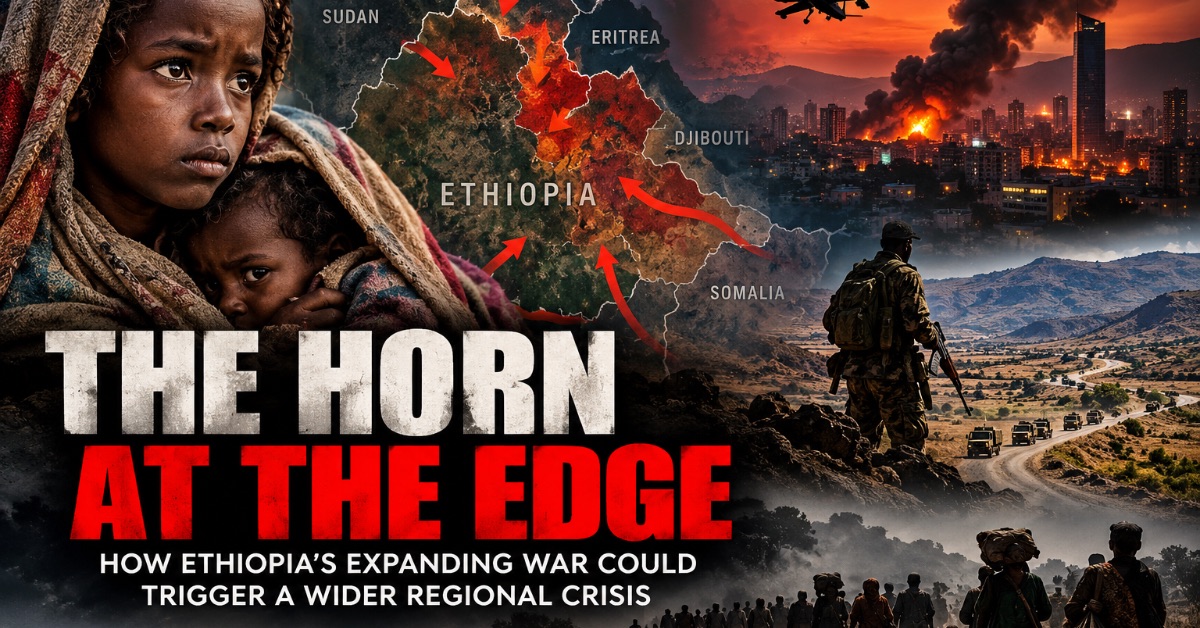
Maps of this conflict increasingly show arrows.
One toward Mekelle.
Another through Afar.
Another toward Amhara.
Potential corridors toward Sudan.
Borders with Eritrea.
Routes toward Djibouti.
But every arrow crosses communities.
Behind the military terminology are farmers, shopkeepers, truck drivers, teachers, students, doctors and children.
For them, regional war would not be experienced as strategy.
It would mean food prices rising.
Schools closing.
Hospitals losing medicine.
Trade disappearing.
Electricity failing.
Families separating.
Young people being recruited.
Businesses collapsing.
Another generation migrating.
And another generation learning that political disagreement in the Horn ultimately ends with weapons.
That outcome is not predetermined.
There is still a choice
The developments of October 1 make the situation more dangerous than it was only days ago.
Federal forces appear to have regained ground in portions of southern Tigray and Afar, although battlefield claims remain incompletely verified.
The opposition alliance remains capable of operating across several fronts.
Explosions have now been heard in Addis Ababa, although claims that opposition drones caused them remain unconfirmed.
Accusations involving Eritrea, Sudan and Egypt continue without sufficient independently verified evidence to establish the allegations as fact.
A possible Ethiopian troop withdrawal from Somalia could create another regional consequence if implemented.
And civilians are already being killed, wounded and displaced.
These developments do not prove that a regional war is inevitable.
They demonstrate why preventing one has become urgent.
Ethiopia, Eritrea, Tigrayan leaders, other Ethiopian armed movements, Sudan, neighboring governments, the African Union, IGAD and influential external powers still possess opportunities to prevent escalation.
Every one of them should use those opportunities now.
Because the Horn of Africa is approaching the point where preventing war will become considerably easier than stopping it after the borders between its separate conflicts disappear.